

Can a denture help me chew and speak without hiding my smile?
People rarely talk about the quiet edits: skipping steak, covering a laugh, choosing the soft side of the menu. When several teeth are gone — or the ones that remain cannot carry a meal — a denture is one way back to ordinary days. Dr. Kurt and Dr. Wyatt Knechtel help Longmont patients choose a partial, a complete set, or an implant-supported option from the mouth in front of them, not a catalog page.
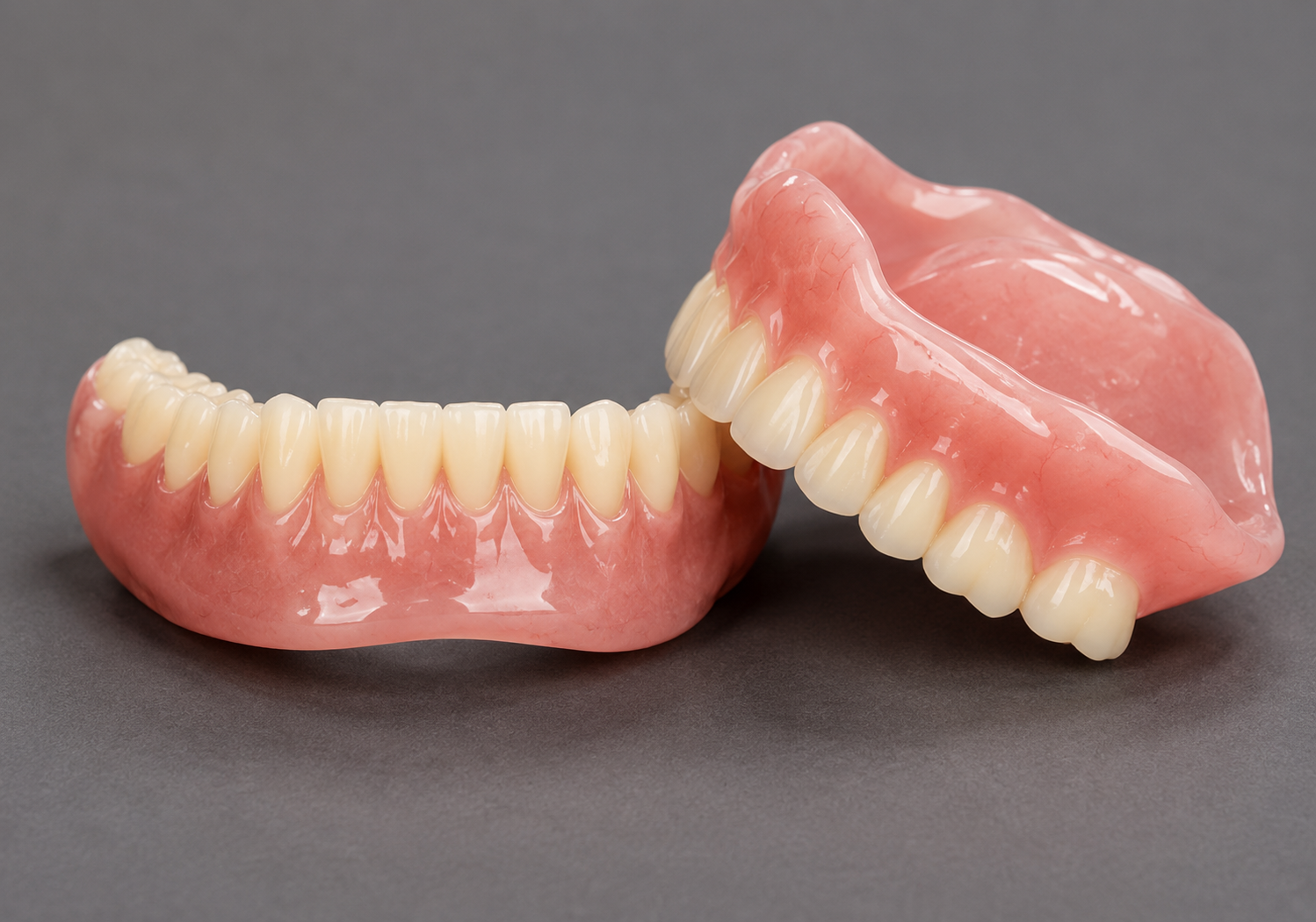
The quiet edits
Teeth wear down from meals, years, injury, and illness. You may only notice when a gap makes speech catch, or when you stop biting into something you used to love. A few remaining teeth, loose teeth, or spaces that will not stay hidden are the usual reasons this conversation starts.
How the teeth were lost — gum disease, decay, an accident — does not close the door. It does mean we look at the gums and bone first, so whatever we make can sit comfortably and any teeth you keep stay healthy.
What you keep, and what you replace
A partial is for the person who still has teeth worth keeping. It fills the spaces so the remaining teeth have neighbors again. Shade and shape are matched on purpose — the new teeth should look like they grew there. The teeth you keep still need brushing, flossing, and exams. The partial is not a hall pass.
A complete denture is for a full arch that is already gone, or for remaining teeth that need to come out so a full set can be made. Porcelain or acrylic teeth sit on an acrylic base. You learn the take-out rhythm: clean it, sleep without it most nights so the gums can rest, store it in water or a denture solution so it keeps its shape.
Myths about dentures
“They always look fake.” They can look obvious when every tooth is the same perfect square. A well-made set follows your smile line and the small differences real teeth have. “Too perfect” is usually the giveaway.
“I should sleep in them.” You can. We do not recommend it. Night is when gums get a break and the risk of irritation goes down.
“If it cracks, Super Glue will do.” Household adhesives can be harmful, and a kitchen repair can ruin the fit. Call us. That is a professional fix, not a drawer project.
The first weeks
The first meals are a practice session. Speech may feel thick for a few days. Adhesive is a helper, not a personality. Most people find a rhythm: rinse after meals, brush with a soft brush and non-abrasive soap — regular toothpaste can scratch — and clean the grooves where adhesive hides.
Some patients want more stability than a conventional denture gives. Implants can hold a denture more firmly when bone and health history allow it. That is a bigger plan and usually a larger investment. It is one option at the table, not the only grown-up answer.
Years, not forever
Gums and bone keep changing after teeth are gone. A denture that fit in year one may need an adjustment later. Many dentures serve about five to ten years with daily care. We do not give a guaranteed lifespan. That is honesty, not a hedge.
If missing teeth have started editing your days, come in and talk it through. Call (720) 815-4733 to schedule at Longmont Dental — serving Longmont, Boulder County, and Northern Colorado.
Interactive guide
Denture questions
Answers about partial, complete, and implant-supported dentures at Longmont Dental.
Ready for dental care that feels like family?
Start with the simplest next step: request an appointment, call the office, or get directions before your first visit.
Use the Call, Directions, or Request options below to get started.